Shopify
Reimagining Onboarding for a Rapidly Evolving Product
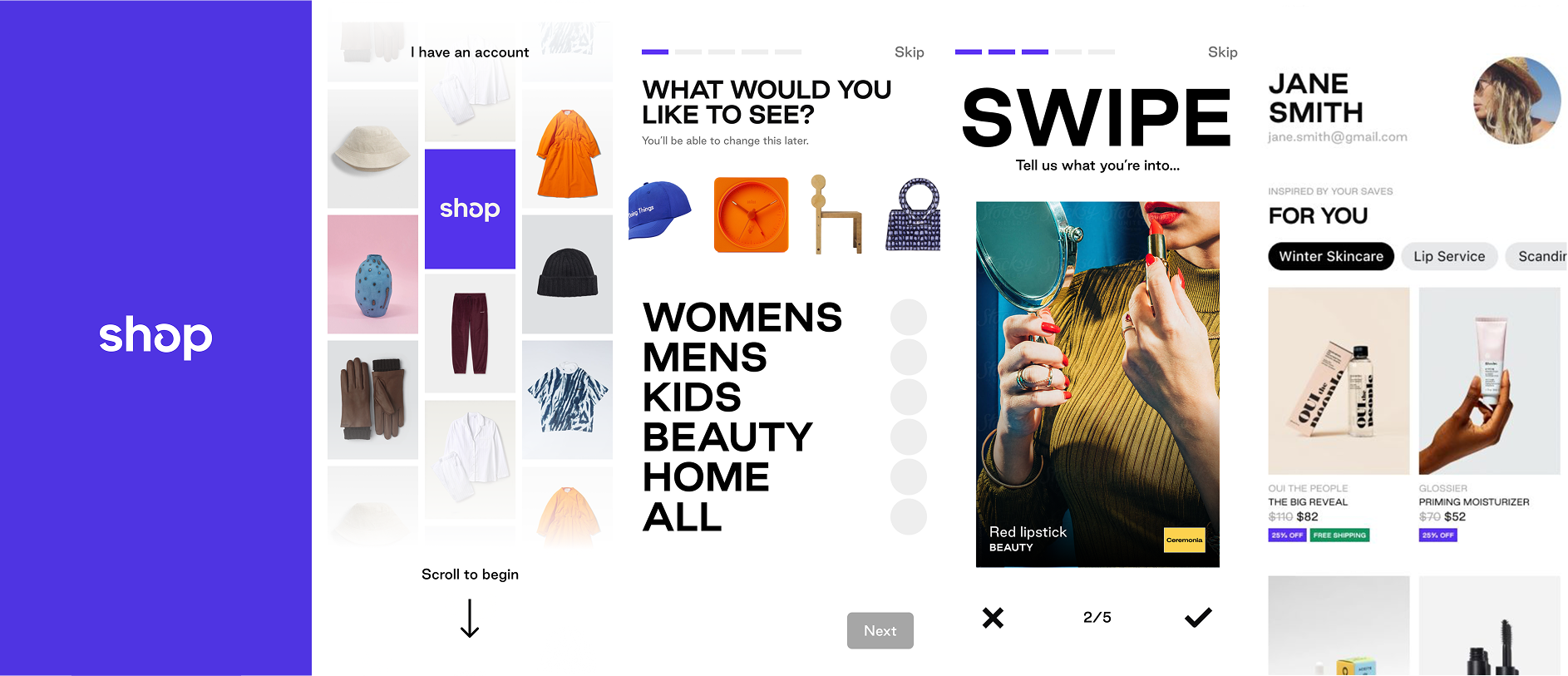
Shop was evolving quickly — from a utility used to track parcels into a broader shopping destination. But most new users still arrived expecting the original value proposition: ~70% downloaded Shop via a “track order” button on order confirmation pages. They expected a package tracker. They landed in a shopping app.
This mismatch showed up clearly: rising negative reviews, confusion in the first session, and a drop in early retention. Onboarding was no longer supporting the product’s shift, nor bridging expectations for users who still came for tracking first.
The problem
We had a three-part challenge:
User expectation gap
Most users expected order tracking, not discovery or shopping. We needed to meet that expectation quickly, while gently expanding their understanding of Shop’s broader value.
Product value-prop shift
Shop’s mission was evolving faster than its first-time experience. Onboarding needed to support a shopping-led future without abandoning the core utility users relied on.
Organisational ambiguity
Growth was structured into three mission teams — Activation, Retention and Infrastructure — each operating with significant autonomy but lacking coordinated direction. Growth had no product lead, Activation had no senior PM, and the team’s roadmap had devolved into disconnected experiments. The team lacked strategic direction and momentum.

Approach
My response to these challenges was a vision-led, hypothesis-driven initiative that would give the team clarity while leaving room for experimentation. Three pillars shaped the work:
- A North Star vision to clarify where onboarding needed to go
- Central hypotheses to guide experiments and learning
- Cross-functional alignment, ensuring onboarding evolved alongside broader product work
This gave the team a coherent direction and the flexibility to explore.
How I led the work
Creating clarity quickly
I led a cross-functional sprint to quickly build shared understanding around first-time behaviour and intent. It revealed the key friction points, established three principles to guide direction, and produced early prototypes that made the future feel concrete.
Our core principles would help serve as a key way for us to align around specific ideas about what onboarding should be:
- Make it personal — Use personalisation to create early, meaningful relevance
- Highlight shopping — Reduce that ‘bait & switch’ feeling by priming shopping intent from the first moment
- Connect the dots — Highlight the a-ha moments in the journey to reinforce the moments where users found value

Designing for 3 buyer segments
When I shared the sprint results with senior leadership, the response was clear: there was appetite for something bigger. The work had the potential to become a central strategic priority — not just an Activation initiative, but a Growth-wide North Star.
I used that moment to expand the scope. Working with the PM and Eng leads, we broadened the remit to account for how onboarding could serve different types of users. This brought Shop’s lead researcher’s segmentation work — already underway in parallel — into sharper focus. Three distinct user groups emerged:
- Tracking-first buyers (majority) — those coming from order confirmation pages
- Organic explorers — people who discovered Shop organically
- Shop Pay-familiar buyers — users who loved Shopify’s checkout option, Shop Pay
This surfaced the core tension: how do we honour the tracking-first value prop while expanding the story? Just focusing on tracking-first buyers wouldn’t be enough to keep up with the quick shift in value proposition. Yet ignoring them would be a set-up for failure, given the majority of our users were acquired this way.
The expanded scope — from a shopping-focused vision for Activation to a holistic North Star for Growth — shaped how we thought about welcoming each segment and how onboarding could adapt across them.
Bringing narrative & research together
To help the team think beyond screens, I introduced a storytelling approach that combined behavioural data, research insights, and upcoming strategic bets across the org.
Working closely with a Staff Designer in the Activation team, I guided us towards mapping future-state buyer journeys for each segment. These outcome-focused stories were rooted in research and showed how onboarding could flex to meet different entry points while still advancing Shop’s shopping-first vision.
Through vision sessions, I acted as a sparring partner and coach toward developing the future-state journeys, connecting future product capabilities with the realities of the first session. This established a narrative spine the team could build from.
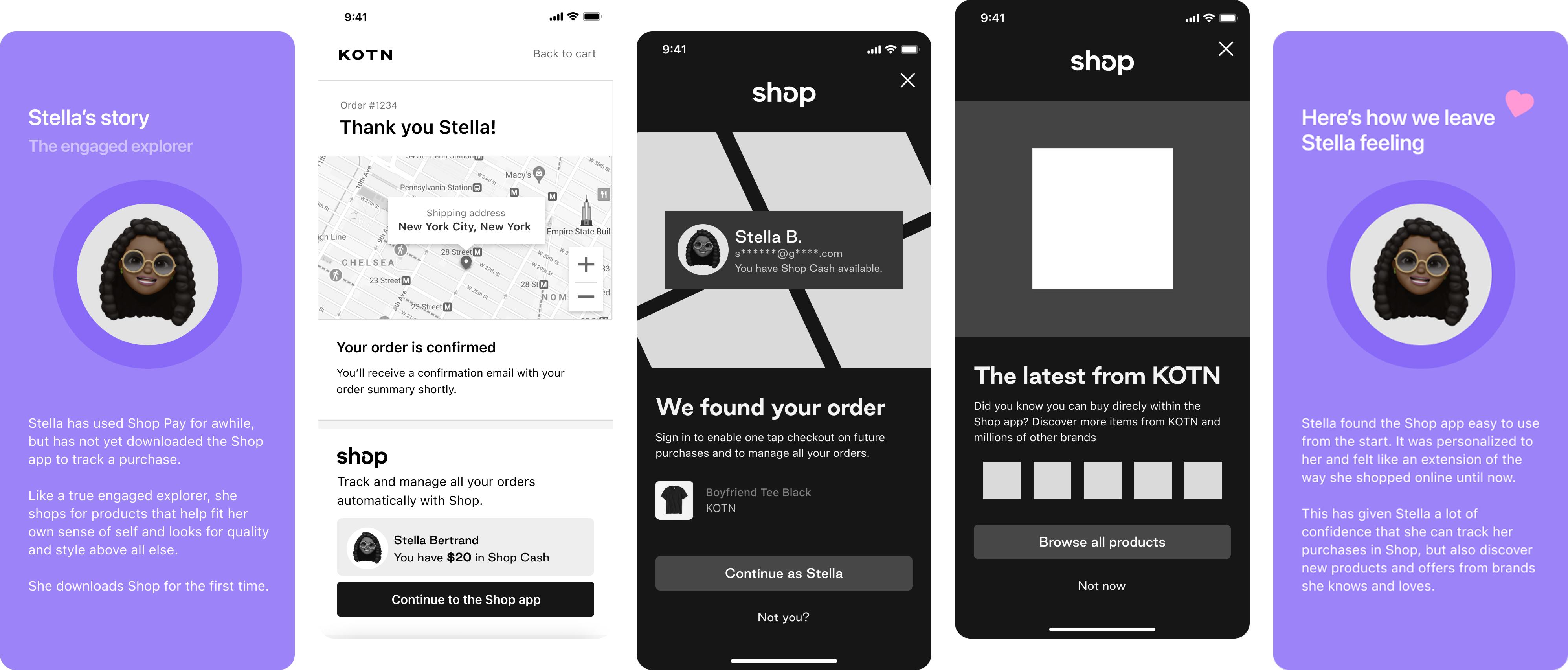
Above is an example of one of our segments, the Shop Pay user. This story weaved upcoming bets (like Shop Cash and Shop ID) with our onboarding principles, such as personalisation and highlighting shopping.
These journeys, combined with our three principles, became the North Star that guided experimentation.
Turning vision to experiments
We translated the principles and journeys into central hypotheses, which then shaped a coherent experimentation roadmap.
Vision principle
Highlight shopping
↓
Central hypothesis
Help buyers quickly understand Shop’s value proposition and remove barriers to starting
↓
Experiment
A one-screen onboarding flow that communicates shopping messaging more clearly
This framework brought structure to the roadmap — giving the team a coherent pipeline of learning-driven experiments to build from.
Beyond MVP experiments, we explored how key onboarding moments could evolve — using prototypes to visualise how brand, motion and narrative could come together to create a more crafted experience.
Thinking beyond the app
As onboarding emerged as a strategic priority, I advocated for a designer dedicated to bridging product and marketing — resulting in a Marketing UX Designer joining Growth.
They partnered with Activation, content design, and lifecycle teams to:
- Craft narrative-driven email onboarding aligned with Activation
- Extend the value story beyond in-app flows
- Create cohesive storytelling across channels
Outcomes
North Star adopted
Growth embedded the onboarding vision as a core strategic focus, giving the team a shared, principle-led direction and a coherent roadmap for experimentation and personalisation.
Product impact
Experiments shipped and contributed to early funnel improvements — including a +9% lift in email verification, a key trust signal tied to stronger retention.
Cross-team cohesion
The initiative strengthened alignment between Growth, Buyer, Merchant, and Shop Pay teams — creating better coordination around onboarding and a shared narrative across channels.