Blinkist
From Functional to Strategic: Evolving the Design Team
By 2019, Blinkist had grown from an early-stage learning app into a global consumer product with rising complexity — new competitors, increasing acquisition costs, and bigger strategic bets.
The Design team had expanded into three disciplines (Product Design, Research, and Visual Communications), but our ways of working hadn’t kept pace. The gap was becoming clear: we needed a stronger design practice to meet the company’s next chapter.
I led an initiative to define how Design should evolve. Not just in process, but in focus, standards, and strategic contribution to the business.
The challenge
Blinkist was entering a new phase. The product was more complex, expectations were higher, and the business needed design to contribute in sharper, more strategic ways. But:
- We were still optimised for speed over scale
- Teams tackled ambiguous work without shared principles
- The team lacked clear direction and alignment with company priorities
The challenge was to elevate design from a high-performing yet functional team to a strategic partner.
Approach
1. Aligning with the founders
I began with 1:1 interviews with Blinkist’s co-founders (CEO, CPO, CTO) to understand their expectations for design and where they saw new opportunities for impact. I paired this with my own perspective on what design needed to deliver at this stage of the company’s growth.
These conversations surfaced seven opportunity themes — from elevating craft to expanding evidence-based decision-making — and established shared expectations for how design would evolve.

2. Defining a unified vision for design
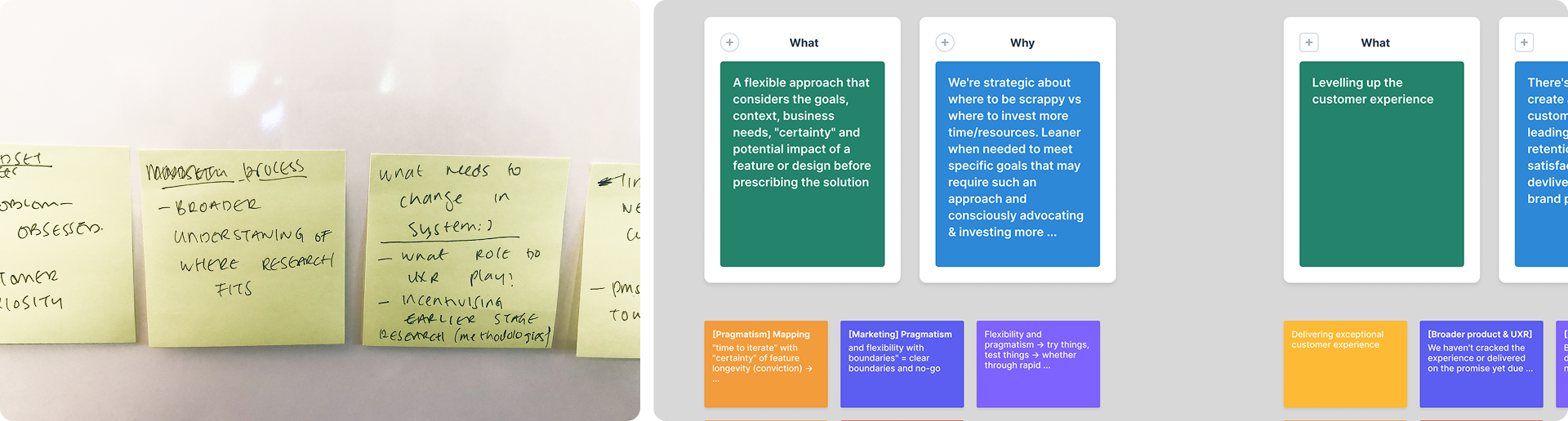
After the interviews, I synthesised the responses — affinity mapping in Whimsical to surface recurring patterns — and identified seven opportunity themes. I also mapped how design contributed to business outcomes: directly through revenue growth, indirectly through engagement and retention, and through organic reach. This gave the themes a business foundation, making it clearer where design should be investing its energy.
With that in place, I ran workshops with the leads of Product Design, Research, and Visual Communications to translate the themes into a clear vision. We:
- Mapped current strengths and gaps
- Defined “desired states” for each theme
- Connected each aspiration to business levers (retention, organic growth, product clarity)
- Identified structural blockers (team size, rituals, process gaps)
This produced a set of vision statements that articulated where we were going, why it mattered, and how design would support Blinkist’s strategic direction.
Here’s an example of one of those themes:
Theme: Exceptional user experience
What: Levelling up the user experience to create a great experience for customers that really differentiates the business
Why: There’s more opportunity to create an exceptional user experience, leading to higher retention and customer satisfaction…
3. Turning vision into team strategies
With the vision defined, the focus shifted from where we wanted to go to how we’d get there. Some themes applied across the org; others sat within specific disciplines. I partnered with each lead to turn the vision into actionable strategies for their team:
- Guiding principles for their discipline
- Prioritised focus areas
- Key initiatives to drive change
- Measurable signals of progress
For example:
- Product Design established UX principles and identified key moments of delight across the user journey, to improve product quality and user retention
- Research defined a clearer approach to evidence-led decision-making
- Visual Comms developed more rigorous approaches to performance-marketing experiments, ensuring the team was better equipped to support customer acquisition and conversion targets

Here’s an example of the theme on Exceptional User Experience taking shape as a ‘desired state’ vision. Outlining these ‘desired states’ gave us a basis from which to uncover key initiatives.
“Our product is ‘best-in-class’; it’s delightful to use, low in friction and beautiful…From the fundamental core tasks being expertly designed to unexpected touches of care and thoughtfulness. The Blinkist product is differentiated and lacks the pain points of our competitors. We’re able to deliver this exceptional experience because designers have the support and confidence to advocate for design-driven topics”
Outcomes
A shared design vision and team-level strategies
Each discipline left with its own strategy — tied back to a shared design vision aligned with founder expectations and business priorities. Together, they had a common language for what “great” looked like and how design would help the company win.
Elevated craft and renewed advocacy
Designers were equipped to connect their work to business impact, advocate for quality, and maintain higher standards in a fast-moving environment.
Strategic follow-on initiatives
The work unlocked new projects across the team, from improved UX principles to more effective performance-marketing experiments.
Org-wide ripple effect
Other teams in the company adopted similar processes to define their own strategic direction — a signal that the approach resonated beyond Design.
Reflections
This initiative repositioned Design as a strategic partner during a critical period of growth. It clarified expectations, strengthened design’s influence, and created the focus and structure needed to tackle increasingly complex product and business challenges.
For many designers, this work reignited something important. The team had grown significantly — splitting from one unit into three distinct disciplines — and with that growth came a loss of shared momentum. Some designers were unsure where they sat within the broader picture, or how to push for more. The initiative gave them a language for that: reconnecting them with the purpose of design at Blinkist and making it clearer where they could spot opportunities and go for them.